or
The Keel of the Delmar
Preface: This is one part of the story of building my boat “Goelette” in Coral Bay, St. John, United States Virgin Islands. This type of boat was known as a “Cowhorn” due to the double ended shape of it’s hull.
As the fiberglass hulls of the “Cowhorns” were taking shape in Coral Bay, St. John, one of the next steps was becoming more pressing. Each of these boats was going to need at least 5,000 pounds of lead for the keel. Since we were all building our boats on a shoestring, everyone was coming up with creative alternatives to simply buying the lead, which would have meant a cash outlay of at least $1800 plus the costs of getting the lead from where we bought it to Coral Bay, where it would be melted in a steel mold to take the shape of the keel.
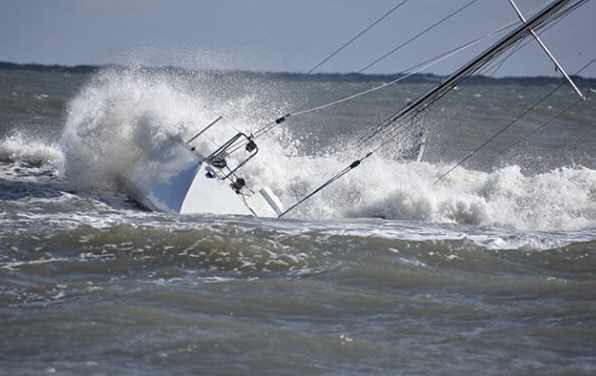
My friend Larry and I had heard about a charter boat that had been wrecked on a reefy area in the Pillsbury Sound between Frank Bay, St. John and the Red Hook St. Thomas. Usually wrecked charter boats were salvaged by the company that owned them for, even wrecked, they were valuable for the sails, hardware and engine. This boat had been named the Delmar and was part of the charter fleet from Avery’s boathouse in St. Thomas. Larry and I knew Dick Avery, the owner of Avery’s Marina and charter boat company. We never really mentioned to him that we were going after the lead in the boat that his company had lost. Frequently the lead would remain in the wreck of the hull and be salvaged along with the other parts of the boat. This time was different. Where the boat had struck and sank was a large area of reef with threads of deep water between the rows of coral. To compound the difficulty that the location presented to the salvagers, the current could run extremely fast as it was a passage between the Atlantic Ocean and the Caribbean Sea.
No one had ever accused neither Larry nor me of being timid or lazy. We went to the wreck site in a 10’ long dinghy powered by a 6 hp outboard and dove the area until we found the keel. It probably weighed in at about 8,000 pounds and was nestled about 12 feet deep between two large patches of coral. Diving in coral is inherently dangerous, because even if you merely brush against it, the sharp edges will shred your flesh and would frequently cause an infected wound. Given the current, we had to pick our time to dive on the keel, when the respective tides of the two bodies of water were causing minimal current and choppiness. We quickly wrapped the keel in stainless steel rigging wire which we would use, eventually, to hoist our leaden treasure to the surface. Having found and marked the site of the keel, we made our salvage plans.
We calculated that we could lift the keel from the bottom by hanging it from a box that we made from plywood and fiberglass and measured 4’ x 8’ x 30”. We fastened robust mounting points on each end of the box, with a come along on one end and a trailer winch on the other. Our plan was to tow the box behind the 10’ dinghy and then attach a stout wire from the trailer winch through the harness around the keel and attach it to the come along. We would crank up the come along to take out all of the slack in our lifting gear and start cranking up the keel with the trailer winch. Being in Salt water the keel weighed less because of the volume of water it was displacing and we thought (hoped) that our home made rig would be strong enough. We also had dive gear, anchors lots of rope and wrenches, hammers, pliers and other essentials.
As we started cranking the load up and the sturdy box began setting into the water under the load, I put on my snorkeling gear so I could watch the keel as we cranked it fee of the bottom. We knew that we couldn’t raise it high enough to clear the entire coral reef, so our plan was to steer it through the reef in the deeper water between the killer coral heads. I had attached one rope from the keel to the dinghy, another from the box to the dinghy and a third from the back of the box that I used to hold on to so that I could be towed along with the box and keel. the idea was that, once the keel was free of the bottom, I could signal to Larry, who was driving the dinghy, which way to steer to navigate through the reef into deeper water and, eventually, to the beach. Once at the beach we would winch the keel up on to the beach and cut it up with chainsaws to transport it, in pieces, to Coral Bay. Sounds like a simple, easy and safe plan, right? Well, compared to some of the stuff we’d already done…it seemed okay to us.
As soon as the keel rose from its sandy resting place I excitedly yelled to Larry that the plan was working and to start towing the whole rig to shore. I gestured wildly giving directions as he steered us through the coral maze. As we cleared the reef into the deeper water, I thought we going to succeed! Then I saw the first strand of wire break on our lifting harness, then another and another! The keel was too heavy for our wire and, with a sudden violent snap, the keel plummeted into 40’ deep water. As the keel crashed to the bottom it took Larry, the dinghy, motor, tools and dive tanks to the bottom with it, thanks to the rope that I had so cleverly tied from the keel to the dinghy. The whole mess, as well as our trusty box was anchored to the bottom by one rope from the keel to the dinghy and another from the dinghy to the box.
Larry and I swam to the box, now bobbing frantically around in the sea, freed from its 8,000 pound burden and held only by a rope. We scrambled on top of the box and surveyed our situation. We were about a mile from shore with no boat and Larry didn’t even have a mask nor fins. After a few minutes of pirate like cursing we knew that we’d have to come up with a plan. I looked under the box and could see that the dinghy was right side up on the bottom with most of it gear still intact. We knew it had enough flotation that, without the weight of tools and dive tanks, it would probably float to the surface where we’d be able to bail it out. A 40’ dive was not all that big of a deal for me in those days as I was in the water all the time and was in pretty good shape. The plan was that I would dive down, put my tank on and start to send, by rope, the motor, tools and other gear up to Larry on the box, so that the dinghy could float to the surface. As we unburdened the dinghy it started to ascend, Lazurus-like from the dead to the light of the sun on the surface. Larry had had the foresight to tie the oars into the dinghy so they wouldn’t be lost in the event of a problem. So, as we bailed the dinghy out we soon had a means of getting to shore. We re-loaded our gear and drowned outboard on to the dinghy and set out rowing to shore. Larry’s wife, Patti, had been waiting ashore with their truck, some chainsaws and other things necessary to complete our plan. I don’t know if she was surprised by our failure or just relieved that we made it back, but she helped us struggle ashore, load up the dinghy, motor and other stuff and we headed across the island back to Coral Bay.
Our day wasn’t over though. We had to disassemble the outboard motor, clean it and flush out to get it running again. While we were doing that task, Larry and I considered our options to get our lead, as we were not going to give up, having already completed the hard part. I was thinking in terms of taking the same rig back out there, with stronger wire and carrying on with the original plan.But Larry, always an outside-the-box-thinker had already, I discovered later, started to formulate a different plan.
We knew this guy named Fergie who had built his own boat, years before, of steel. He was rightfully proud of it, as it was stoutly constructed with an oversize diesel engine and a massive anchor winch. Fergie’s boat was like Fergie…big and strong. He had hands like baseball mitts and loved to tell stories. Larry always liked to tell stories too and had a knack for it. One evening he was at our local bar, Redbeard’s, along with just about every other sailor in Coral Bay. Larry was telling Fergie about our lead adventure and posited “If only we had access to a strong boat, with a powerful anchor winch, we could probably pick this lead up and get it to shore”. Fergie responded “I bet that Poseidon ( Fergie’s boat ) could do it”. Larry, sensing that he had a nibble on the bait said “Nah, even your boat probably isn’t powerful enough”. The hook was set, Fergie insisted that he, and his boat could do it. “Nah” Larry said…”I mean Poseidon is a strong boat, but….I don’t know”. Fergie insisted that he could do it and, damn it, he would do it. Beers were bought, toasts were made and we made our plans.
We would prepare by rigging a new, stronger harness so we wouldn’t lose the lead again in an even worse place. That task was soon accomplished and with a fresh marker buoy attached, we were as ready as we could be.
On the appointed day, we met up with Fergie and the powerful Poseidon, having arranged with the local shipyard to haul the lead out of the water, if we could bring it into the slip below the boat lift. Patti was going to meet us in Cruz Bay with the truck and chainsaw. Off we went with Fergie on a mission. Fergie was probably as excited as we were, maybe more. The day was perfect for it, not too much wind, calm water and little current. As we came up to the buoy marking our leaden treasure we were excited even though Larry kept telling Fergie, he didn’t think that he could do it. We snagged the buoy and led the wire through the leads to Poseidon’s windlass. We took a few turns around it and hit the button to start the rotation. As the slack came out of the line, the bow of the boat started to drop lower into the water as the full weight of the lead was being realized. Just when we thought that there was no way we could crank it up high enough, Fergie put Poseidon in gear and started to drive her into shallower water near on shore. As the water got shallower we were able to crank the lead up closer and closer to the boat’s bottom. Eventually the lead was hanging only a few feet beneath the stout bow of the mighty Poseidon. We started to slowly head for Cruz Bay, worrying that, at any second, something would fail and our lead would be forever lost in an inaccessible area. We must have been quite a sight as Poseidon’s bow was probably 3 or 4 feet lower than it would normally be and the stern was so high, the propeller was barely finding purchase in the turquoise water.
Bit by bit, we approached the boat lift, which was lowering its straps to the bottom to snare the lead for lifting. We inched into place and the straps of the lift encircled our lead and started to lift letting the bow of the mighty Poseidon resume its normal level. As the entire weight of the lead keel was borne by the boat lift, Fergie backed his boat out and tied it up. Eventually the lift had the keel up to the level of the dock and it was able to drive into the parking area with our prize. We set it down on some wood timbers so that we would be able to cut it up into segments that we could load into a heavy duty truck that we had rented.
We finally got our lead prize back to Coral Bay, where we attacked it with chainsaws to divide it equally between us to be, eventually, melted down and cast into keels for our new boats. Of course, the Coconut Telegraph was fully functional back in those days and word soon got back to Dick Avery of our taking his lead. Honestly, we were within our rights to salvage it, but it was still notable that we had done it.
Sometime later, as out boats were nearing completion, Dick Avery and his wife, Marianne, sailed into Coral Bay. They were curious to see the progress on the boats and Coral Bay was a nice place to sail to anyway. Dick came ashore, strolled though our makeshift boatyard and, at some point, stood looking at my boat and Larry’s boat with his hand to his chin and head cocked. After a minute or so, he said in his Downeast Maine accent, well, they look like Delmars to me. That was his only acknowledgement of our pirating of the Keel of the Delmar. We were told later that he was pleased that something that was lost to him, had gone to help other sailors realize their dream.

 My Thoughts, Exactly
Leave a reply to The Journalist BS Cancel reply